


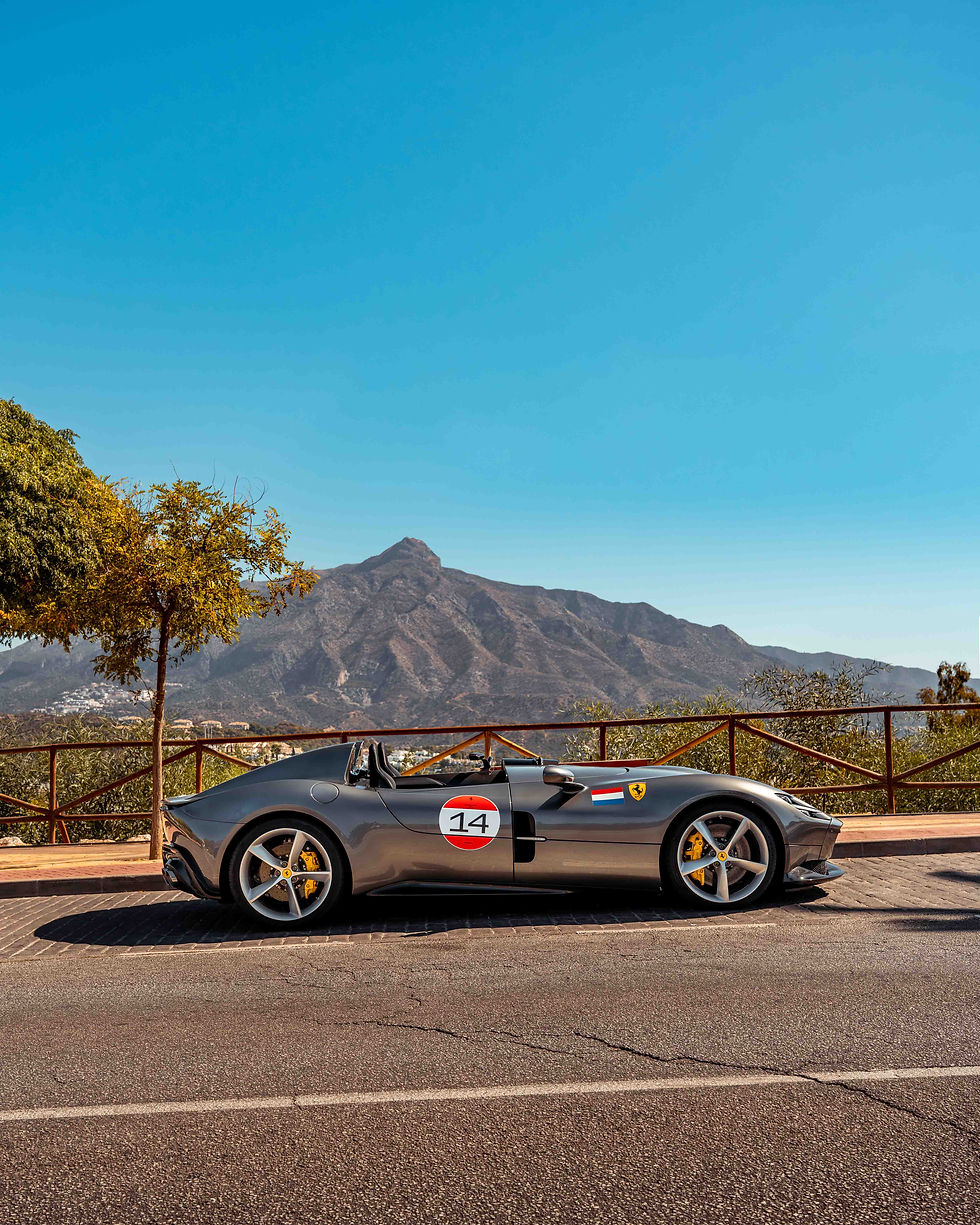
Our Monza SP2
The Monza SP1 and SP2 marked the introduction of Ferrari’s Icona series, conceived as something fundamentally new within the marque rather than a continuation of existing model lines.
Instead of being driven by homologation requirements or a single technical milestone, Ferrari presented Icona as a design driven limited series, ultimately planned to consist of five models. Each car is intended to reinterpret one of Ferrari’s most iconic creations of the past.
The Monza twins draw inspiration from Ferrari’s 1950s and early-1960s barchettas, with an emphasis on purity of form, proportion, and mechanical exposure. These elements are expressed through modern surfacing and aerodynamic solutions rather than retro detailing.
Our Monza SP2 is finished in historic Grigio Ferro featuring a livery in Argento Nurburgring, and pays tribute to the Ferrari 275 GTB/C Speciale.

275 GTB/C Speciale
Our Monza SP2 pays tribute to the Ferrari 275 GTB/C Speciale chassis 06701, widely regarded as the most extreme evolution of Ferrari’s front-engined GTO competition cars.
Unlike the road based 275 GTB/C, the Speciales were developed directly by the factory as homologation and development cars with no intention to series production. Fitted with a lightweight aluminium bodywork, a reduced section tubular chassis, and a dry sump V12 derived from Ferrari’s racing programme, the Speciales were both significantly lighter and more powerful than any other 275.

Windscreen blade
To preserve the purity of the speedster layout, the Monza SP2 is fitted with Ferrari’s patented aerodynamic wind deflector, often referred to as the windscreen blade. Rather than using a conventional screen, a carbon fibre element ahead of the cockpit accelerates airflow upward and over the driver’s head.
This system creates a controlled air curtain that reduces turbulence and lift around the cockpit at speed, allowing the car to be driven even without a helmet while maintaining the clean visual line of the bodywork.

Clamshell bonnet
The Monza SP2 uses a front-hinged clamshell bonnet not only for design purity but for functional efficiency. By integrating the entire front section into a single carbon fibre panel, Ferrari reduced panel count and mounting complexity, saving weight and improving structural stiffness. It also allows cleaner aerodynamic management over the nose and significantly improved access to front-mounted components during servicing


